
If you are buying a block of flats, the stamp duty rules are not the same as they are for a single buy-to-let. Most investors assume a block is taxed the way a second home is: full residential rates plus the 5% surcharge on every band. On a seven-figure purchase, that assumption can cost you tens of thousands of pounds you never needed to pay.
There is a rule that treats a block of six or more flats as non-residential property for stamp duty. That switches you onto a much lower rate scale, and on most blocks the saving runs into the tens of thousands. It is one of the biggest tax wins in property, and it is quietly missed all the time, because it hinges on how you structure the purchase, and that decision sits with you as the buyer.
Here is how the rule works, a worked example on a real-world block, and the accounting that has to sit behind it so the numbers hold up.
What’s on this page? ▾
- Why a block is taxed differently from a single flat
- The six-or-more rule: non-residential stamp duty rates
- A worked example: the saving on a £1.2m block
- What the abolition of Multiple Dwellings Relief changed
- Freehold, leasehold, ground rents and service charges
- Per-unit tracking: knowing which flat actually makes money
- Planning your exit: splitting the title
- FAQs
Why a block is taxed differently from a single flat
Stamp Duty Land Tax has two separate rate scales. One is for residential property, the other for non-residential and mixed property. The residential scale is the higher of the two, and when you already own property, a 5% surcharge is added to every band on top.
When you buy a single flat as an investment, you land squarely on the residential scale with the surcharge. There is no way around it. But a block of flats is a different kind of purchase, and the law recognises that. Under the stamp duty legislation, a purchase of six or more separate dwellings in a single transaction is treated as non-residential property. That one line changes which rate scale applies to the whole deal.
This is not a loophole or an aggressive scheme. It is written into the rules, and HMRC applies it as standard once the conditions are met. The catch is that it only helps you if you buy in a way that meets the conditions, so how you structure the purchase matters, and it is worth planning before you commit.
The six-or-more rule: non-residential stamp duty rates
The condition is straightforward. You need to buy six or more dwellings as part of a single transaction, or as linked transactions that form one arrangement. A block of flats bought in one go almost always qualifies, because each self-contained flat counts as a separate dwelling.
Once you are treated as non-residential, you come off the residential scale entirely. That means no 5% surcharge, and a much gentler set of bands. Here is the difference for England and Northern Ireland.
| Band | Residential rate (additional property) | Non-residential rate |
|---|---|---|
| Up to £125,000 | 5% | 0% (up to £150,000) |
| £125,001 to £250,000 | 7% | 2% (£150,001 to £250,000) |
| £250,001 to £925,000 | 10% | 5% (above £250,000) |
| £925,001 to £1.5m | 15% | 5% |
| Above £1.5m | 17% | 5% |
The residential scale climbs to 17%. The non-residential scale tops out at 5%. On a large purchase, that gap is enormous, and it is why the six-or-more rule is worth understanding before you sign anything.
A quick note on geography. Stamp Duty Land Tax applies in England and Northern Ireland. Scotland has its own tax, Land and Buildings Transaction Tax, and Wales has Land Transaction Tax. The principle of a lower non-residential scale exists in all three, but the rates and thresholds differ, so the numbers below apply to England and Northern Ireland.
A worked example: the saving on a £1.2m block
Say you buy a block of six flats for £1.2 million, which is £200,000 per flat, in a single transaction. You already own property, so the surcharge would normally apply.
If it is filed as residential, with the 5% surcharge:
| Band | Rate | Tax |
|---|---|---|
| £0 to £125,000 | 5% | £6,250 |
| £125,001 to £250,000 | 7% | £8,750 |
| £250,001 to £925,000 | 10% | £67,500 |
| £925,001 to £1.2m | 15% | £41,250 |
| Total | £123,750 |
If it is treated as non-residential under the six-or-more rule:
| Band | Rate | Tax |
|---|---|---|
| £0 to £150,000 | 0% | £0 |
| £150,001 to £250,000 | 2% | £2,000 |
| £250,001 to £1.2m | 5% | £47,500 |
| Total | £49,500 |
Same block, same price, same buyer. The difference is £74,250. That is money that stays in the deal, funds the first round of works, or covers the void period while you get the flats let. It comes down entirely to how the transaction is classified when the return is filed.
The saving scales with the purchase price. On a larger block it is bigger still, because the residential scale keeps climbing to 17% while the non-residential scale stays at 5%. This is why the rule matters most on exactly the kind of deals where the stakes are highest.
What the abolition of Multiple Dwellings Relief changed
If you have bought multiple properties before, you may remember Multiple Dwellings Relief. It let you work out stamp duty on the average price of the dwellings rather than the total, which softened the bill on portfolio purchases. It was abolished on 1 June 2024, and it is not coming back.
A lot of investors heard that news and assumed the door to stamp duty savings on portfolios had closed. It did not. Multiple Dwellings Relief and the six-or-more rule were always two separate things. The relief is gone, but the six-or-more rule sits in a different part of the legislation and is untouched. If anything, its abolition makes the six-or-more rule more important, because it is now the main route to a lower stamp duty bill on a block.
The practical point is this. On a purchase of six or more dwellings, you no longer have a choice to weigh up between the relief and the non-residential rates. The non-residential treatment is the route, and getting it applied correctly is the whole game.
Not sure whether your next purchase qualifies, or whether your last one was filed correctly? Book a strategy call and we will run your numbers with you before you commit.
Freehold, leasehold, ground rents and service charges
The stamp duty saving is the headline, but a block of flats runs differently from a single property once you own it, and the accounting has to reflect that from day one.
Most blocks are held as a freehold with individual leasehold flats underneath. As the freeholder you may collect ground rents and service charges from leaseholders, and those have their own rules. Service charge money is not your income. It is held on trust for the leaseholders and has to be kept in a separate designated client account, accounted for separately, and spent on the building. Mixing it with your own rental income is one of the most common and most serious mistakes we see on blocks, and it is exactly the kind of thing that surfaces at the worst possible moment, in a dispute or a sale.
Ground rent, where it still applies, is your income and is taxed as property income. Rent from the flats you let is property income too. Keeping these streams clearly separated in your books is not optional housekeeping. It is what lets you see the true return on the building and stay on the right side of the rules on leaseholder money.
Per-unit tracking: knowing which flat actually makes money
A block looks like one asset, but it behaves like six small businesses under one roof. One flat might be tenanted and profitable, another empty for three months, a third eating repairs. If your bookkeeping treats the block as a single line of rent in and costs out, you cannot see any of that.
Tracking income and costs per flat changes what you can do with the building. You can see which units justify their service charge, which are dragging on the yield, and where the maintenance spend is really going. When it comes to refinancing or selling, a lender or buyer who can see clean per-unit figures will move faster and value the block more confidently. Set up in Xero with a tracking category per flat, this takes almost no extra effort once it is running, and it turns your accounts into a management tool rather than just a compliance exercise.
Planning your exit: splitting the title
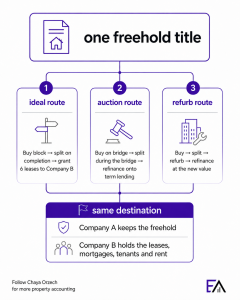
Buying the block well is half the job. The other half is knowing how you get your money back out. Many investors buy a block precisely so they can split the freehold into individual leasehold titles later and sell or refinance the flats one by one, which usually realises more than selling the block whole.
That exit has its own tax treatment, and it needs to be planned before you buy, not after. How the split is taxed, whether the profit is a capital gain or trading income, and how the accounts have to tell that story all depend on decisions made at the start. We have written a full guide to how that works in title splitting explained, and it pairs directly with the purchase side covered here.
If you are also weighing up whether to hold the block personally or through a company, that decision interacts with both the purchase and the exit, and we cover it in our guide to using a limited company for buy-to-let.
Frequently asked questions
How many flats do I need to buy to get the non-residential stamp duty rate?
Six or more separate dwellings, bought in a single transaction or as linked transactions forming one arrangement. Each self-contained flat with its own facilities counts as a dwelling, so a block of six qualifying flats meets the test.
Do I still pay the 5% surcharge on a block of six or more flats?
No. Once the purchase is treated as non-residential under the six-or-more rule, the 5% additional-property surcharge does not apply. The surcharge only sits on the residential rate scale, and you are no longer on it.
Was this affected when Multiple Dwellings Relief was abolished in June 2024?
No. Multiple Dwellings Relief and the six-or-more rule are separate. The relief was abolished on 1 June 2024, but the six-or-more rule remains in force and is now the main route to a lower stamp duty bill on a block.
Can I claim the non-residential rate on a block I have already bought?
Possibly. If your purchase of six or more dwellings was filed as residential when it should have been non-residential, there may be scope to amend the return and reclaim the overpaid stamp duty. There are time limits, so it is worth checking sooner rather than later.
Does this apply in Scotland and Wales?
The example figures apply in England and Northern Ireland, where Stamp Duty Land Tax applies. Scotland uses Land and Buildings Transaction Tax and Wales uses Land Transaction Tax, both with their own non-residential rules and rates. The principle is similar but the numbers differ, so get the position checked for the country the property is in.