
Property investors, landlords and property developers usually switch accountants because their accountant only reacts. The accounts and returns get done, but nobody plans ahead, explains what’s coming or understands how a property business really works.
We know this because we went back through 61 recorded first calls with people thinking of working with us, between 2024 and 2026. Most were property investors, landlords and property developers, from a first buy-to-let company up to groups of 5 companies. A few ran other businesses. Names and details are left out.
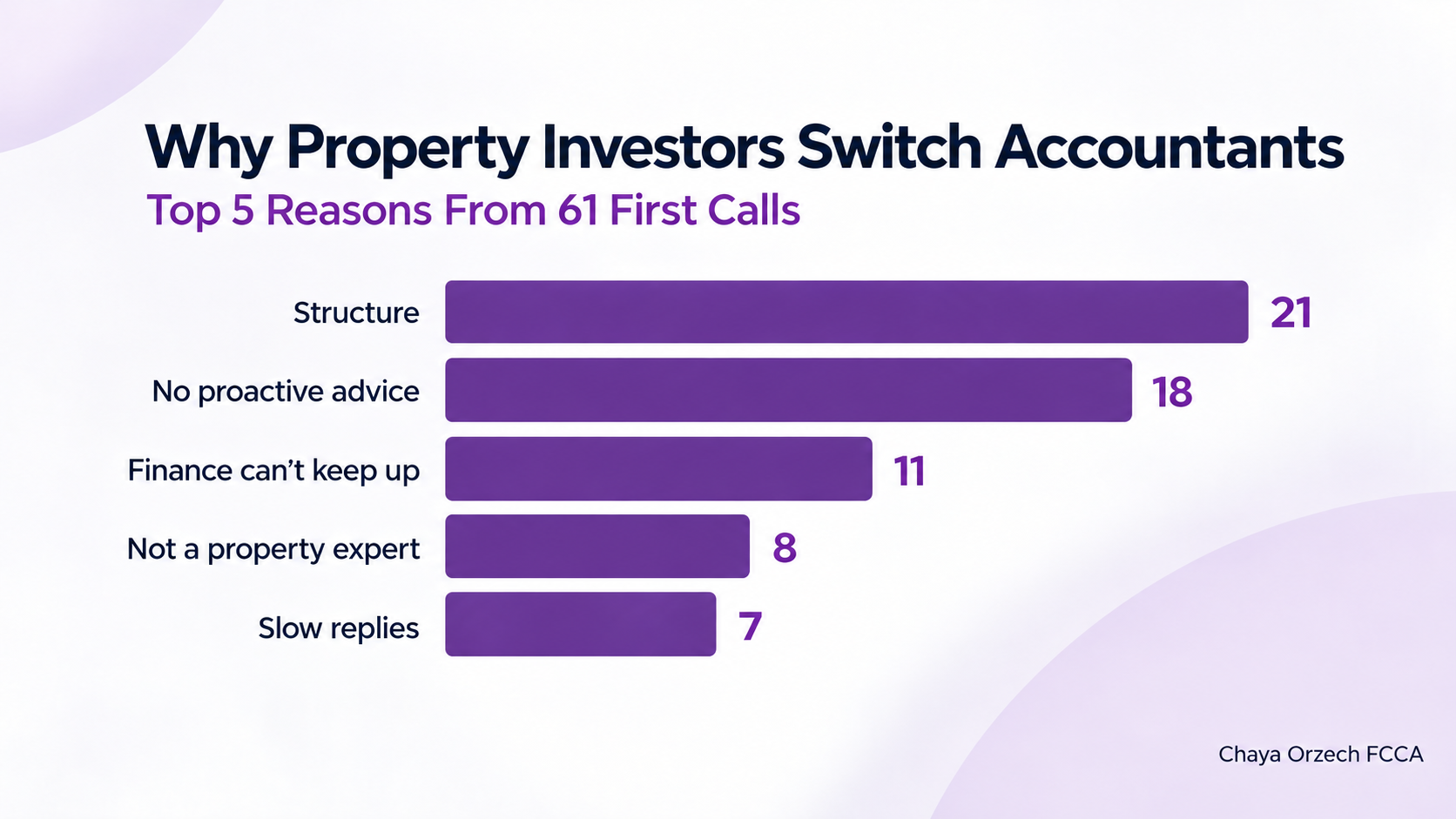
These are the 5 problems that came up most, and how many of the 61 calls each one came up in:
- Getting the company structure right: 21 calls
- No proactive advice: 18 calls
- A finance setup that can’t keep up with a growing portfolio: 11 calls
- An accountant who doesn’t understand property: 8 calls
- Slow replies: 7 calls
Lack of proactive advice was the most common complaint about a current accountant. Structure came up even more often, mostly from people about to buy. Many people raised several of these on the same call. Missed deadlines, unexpected tax bills and not knowing how each property is performing came up too, and we cover them below.
What’s on this page? ▾
- What is the most common reason property investors change accountant?
- Do landlords and property developers need a specialist property accountant?
- How quickly should your accountant reply?
- Can you see how each property in your portfolio is performing?
- When should you decide your property company structure?
- What happens when your accountant misses a deadline?
- Is your finance function keeping up with your portfolio?
- Why do property developers get unexpected tax bills?
- A quick checklist
- Why good accounting is hard to see
- FAQs
What is the most common reason property investors change accountant?
A lack of proactive advice. It came up in 18 of the 61 calls, more than any other complaint about a current accountant. The accountant files what’s due, but nobody tells the investor what’s coming, or what they could change while there’s still time.
One property business owner said: “I wasn’t given anything proactive.” He’d send his statements in, then hear nothing until “the month before the deadline”. An investor with a group of companies said he didn’t want to be “scurrying around at the 11th hour trying to put everything together.”
Tax planning only works before the year ends. A proactive accountant for property investors checks in through the year and tells you what your tax looks like before the bill arrives.
Do landlords and property developers need a specialist property accountant?
If you’re doing more than holding one or two buy-to-lets, yes. In 8 of the 61 calls, people told us their accountant didn’t understand property. Each property strategy is taxed in its own way: HMOs, BRR (buy, refurbish, refinance), title splits, flips, rent-to-rent, holiday lets and serviced accommodation, commercial-to-residential conversions and new-build developments. Refinances, bridging, group structures and 5% VAT on conversions all change the accounts and the tax as well.
An investor with 3 companies told us his accountant was very good at “the normal side of things”, but on his actual strategy, “they don’t really understand that side.” A family development business said they “needed someone who’s more of a property expert.”
A quick test: ask your accountant what happens in the accounts when you title split a block, or when you refinance a BRR property and pull your money out. Clear answers tell you a lot.
How quickly should your accountant reply?
Within a day or two. In property, slow replies cost deals. Slow replies came up in 7 of the 61 calls.
“Even when the deadlines are coming up for the company accounts, it’s me chasing them,” one investor told us. He’d waited about a month for a reply while trying to buy a company with properties in it, and “I actually lost that deal.”
Agree a reply time before you sign up. At ECCO we aim to get back to every email, call or WhatsApp within one working day.
Can you see how each property in your portfolio is performing?
Many investors can’t. “I don’t really know what I’m earning,” one business owner said on our first call.
Another investor described it perfectly: “If I’ve got a rotten apple in my basket, I need to know which apple is rotten.” A portfolio can look healthy overall while one or two properties lose money every month.
The fix is to track every income and cost against the property it belongs to, every month. Our free Property Portfolio Tracker is a simple way to start.
Not sure your accountant is planning ahead for you? Book a free discovery call and we’ll talk through how your finance side is set up, and whether we’re the right fit for you.
When should you decide your property company structure?
Before you make the offer. Structure came up in 21 of the 61 calls, more than anything else. Several people told us their structure was sorted after the deal was already moving. One family development business said “the way we probably set up might not be 100% correct” and wished they’d had “better advice at that initial stage.”
Structure is hard to change once the property is bought and the lending is in place. Moving property or land into another company or ownership later will almost always have significant tax implications, including capital gains tax and stamp duty. Speak to your accountant first, then the broker, then the solicitor. Our guide to buying in a limited company or your personal name goes through the choice.
What happens when your accountant misses a deadline?
You pay for it. One business owner told us “we hit the deadline” and he paid for an extension because his books weren’t reconciled in time. A developer described the stress of papers “not filed on time”.
Penalties are the obvious cost. The bigger risk is a lender asking for recent accounts and finding out they’re late. Ask your accountant for every deadline for the year ahead, in writing.
Is your finance function keeping up with your portfolio?
As portfolios grow, the old setup often can’t keep up. This came up in 11 of the 61 calls. A fast-growing investor told us he wanted someone who could work with him so that “I don’t have to think about” the finance side. Another had asked for a cash flow report more than once and never got one: “anything above compliance is hard to motivate people to do.”
Growing portfolios need monthly books, management accounts, cash flow forecasts and a plan for the year ahead. That’s what our Virtual Finance Office gives you. Clean monthly books come first, and our guide to common Xero bookkeeping mistakes in property businesses shows what to look for.
Why do property developers get unexpected tax bills?
Usually because nobody planned for the tax when the deal numbers were worked out. A family development business told us they’d been “caught out with an unexpected tax bill” and had been “overpaying on VAT”. They’d put the profit from their first project straight into the next one, and the tax arrived just as cash was tightest.
Treat tax as one of the costs of every deal, alongside finance and build costs. If you’re doing conversions, read our guide to 5% VAT on property conversions and empty homes.
A quick checklist
- When did your accountant last contact you about something other than a deadline?
- Do they understand your strategy without you explaining it?
- Do you get replies within a day or two?
- Can you see how each property did last month?
- Was your structure decided before you bought?
- Do you know your tax bill before it arrives?
If you answered no to 3 or more, it may be time to talk to an accountant who specialises in property investors, landlords and developers. Moving is simpler than most people think. Our guide to how to switch property accountants explains the handover step by step.
Why good accounting is hard to see
When a client comes to us after a few years of these problems, everything we do looks amazing. Clients who start with us on day one get exactly the same service, and they don’t run into these problems.
How do you put a value on a problem that never happened? Or on peace of mind? We can’t measure it. But buying a property is stressful enough: the offer, the finance, the solicitors, the completion date. You don’t need extra stress from the accounts, the tax and the deadlines on top of that. You want that side sorted for you, so you can put your time and energy into the next deal.
Thinking about moving accountant? Book a free discovery call and we’ll see whether we’re the right fit for you and your portfolio.
Want this handled for you? See how we work as an accountant for landlords.
Frequently asked questions
What should I ask a new property accountant before I sign up?
Ask how often they’ll contact you through the year, how quickly they reply, and which property strategies they work with, such as HMOs, BRR, title splits, holiday lets and serviced accommodation, and conversions. Ask whether they’ll show you your tax bill before the year ends, and for every deadline for the year ahead in writing.
Is it worth switching accountant if I only have a few properties?
If you plan to grow, yes. The decisions that cost the most, like whether to buy in a company or your own name, are made early, often on your first few properties. If you’re holding one or two buy-to-lets with no plans to buy more, a good general accountant may be enough.
What does a property accountant do that a general accountant doesn’t?
A property accountant understands the strategies behind the numbers: HMOs, BRR and refinancing, title splits, flips, group structures, VAT on conversions, holiday lets and serviced accommodation, and how each one affects your tax. They can plan around your next purchase, as well as filing what’s due.
How often should I hear from my accountant?
More than once a year. If you’re growing, expect regular check-ins through the year, and a clear view of your tax before the year ends.
What is a Virtual Finance Office?
It’s a full finance function run for you: bookkeeping, payments, management accounts, cash flow forecasting, planning and so much more, without hiring an in-house team.
Related reading: How to switch property accountants · Limited company or personal name for buy-to-let